Stockholm City Museum: How a City Became Modern — One Decade at a Time
Cities rarely change quietly.
They expand, fracture, reorganise — often faster than the people living in them can adapt. At Stockholm City Museum, this process is made visible through one of the museum’s most insightful exhibitions: a decade-by-decade portrait of Stockholm from the 1880s to the early 1900s.
Rather than telling history through grand monuments or famous names, Stadsmuseet focuses on the mechanics of everyday life: work, housing, technology, protest, reform. The result is a grounded, human account of how Stockholm entered modernity — and what that transformation demanded from its residents.
A City Under Pressure
By the late 19th century, Stockholm was growing at an unprecedented pace. Industrialisation drew people into the city faster than housing, sanitation, and infrastructure could keep up. Electricity, trams, telephones, and railways arrived with promise, while overcrowding, poverty, and public health crises followed close behind.
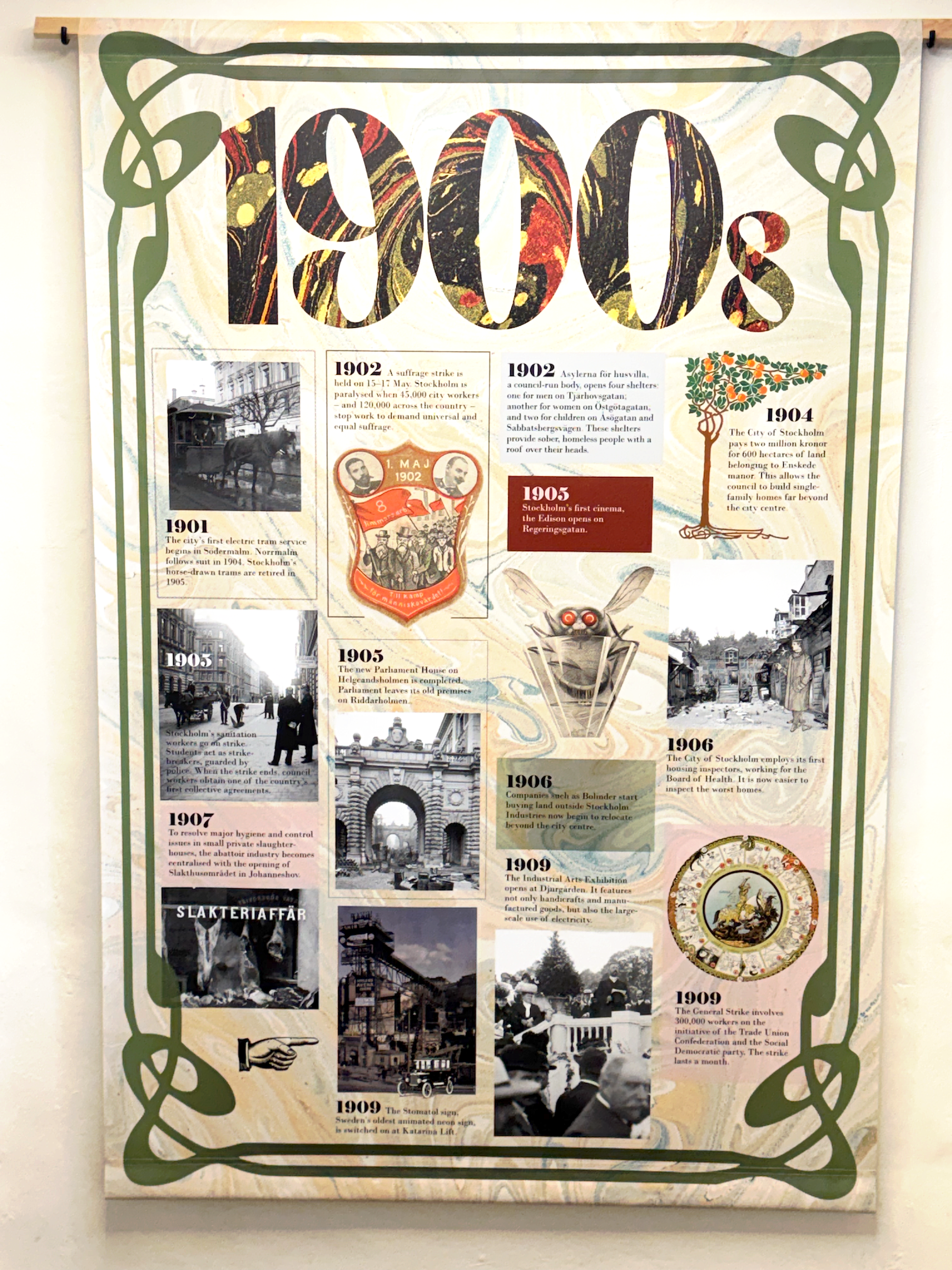
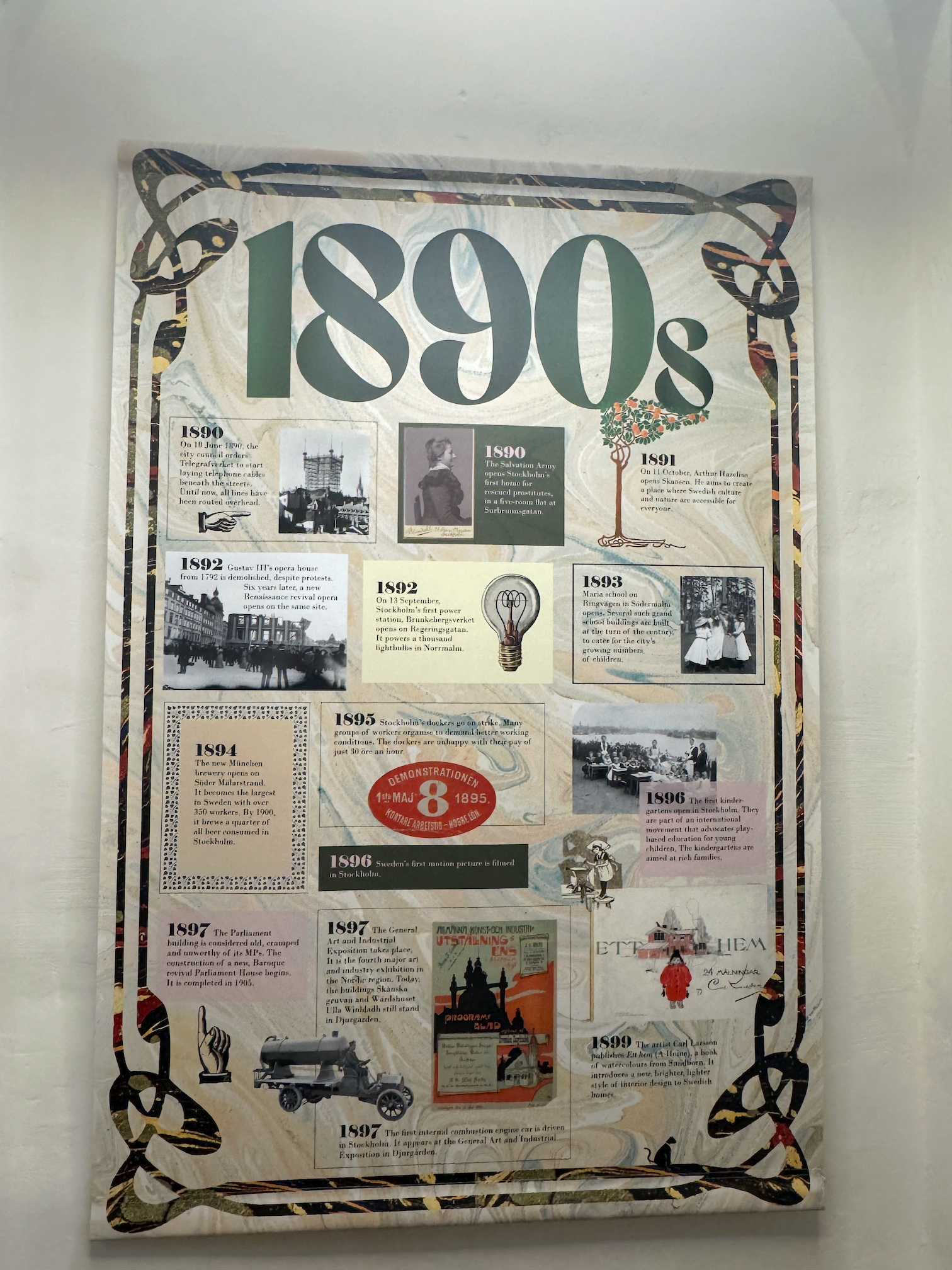
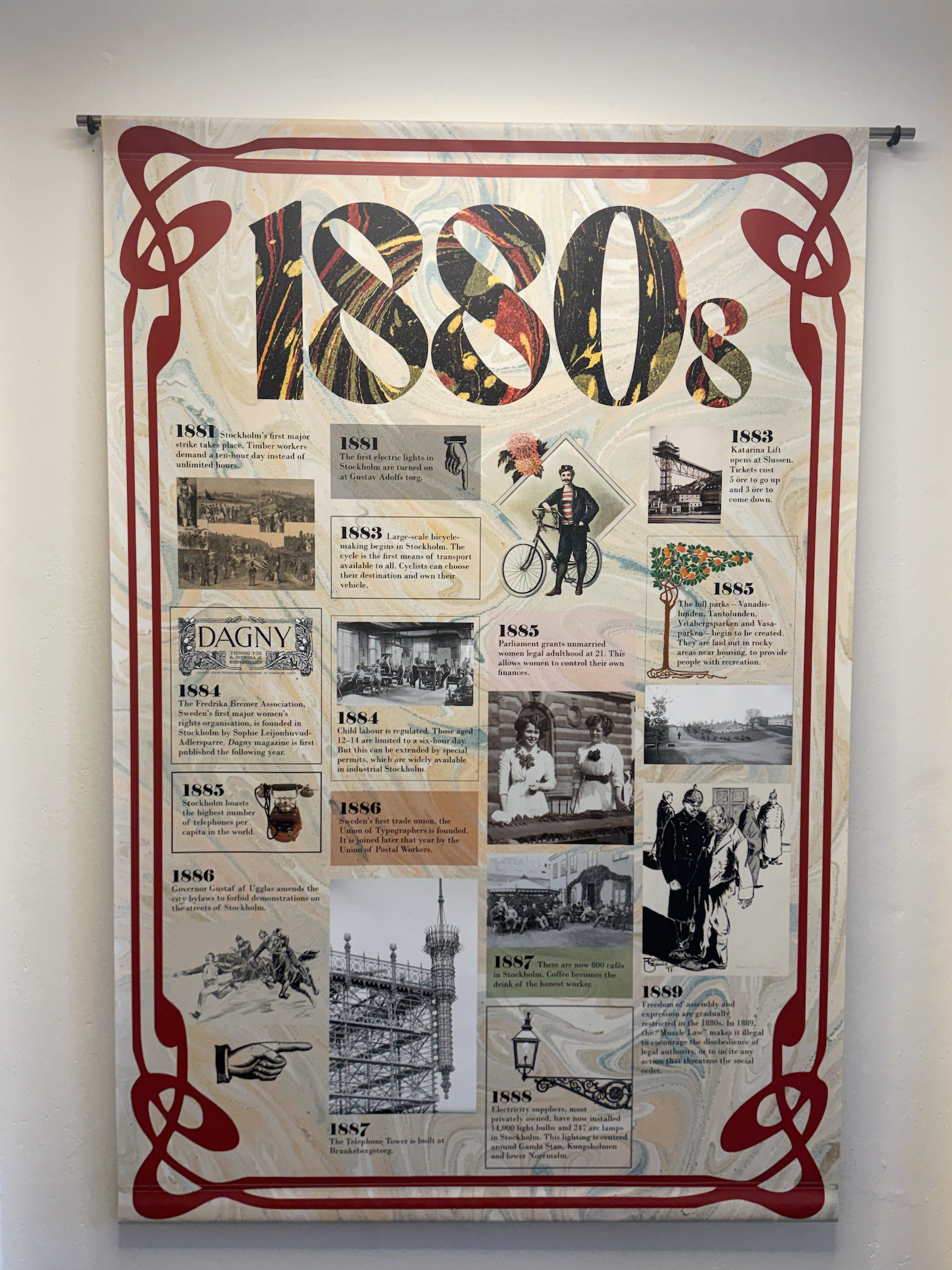
The exhibition’s large visual timelines — spanning the 1880s, 1890s, and early 1900s — capture this tension with striking clarity. Technological breakthroughs appear alongside labour strikes. Urban expansion runs parallel to political unrest. Progress and precarity coexist on the same wall.
This is not history presented as triumph. It is history presented as consequence.
The 1880s and 1890s: Innovation Meets Resistance
The panels covering the 1880s show a city discovering new systems of movement, light, and communication. Electric lighting replaces gas. Public transport expands. Bicycles and trams reshape mobility. Stockholm becomes faster, louder, and more interconnected.
But speed comes at a cost. Workers organise against long hours and unsafe conditions. Public debates around housing, hygiene, and morality intensify. Early women’s organisations challenge legal and economic dependency. The city becomes a site of negotiation between power and pressure.
In the 1890s, these tensions sharpen. Labour movements gain visibility. Urban planning begins to emerge as a political tool rather than an afterthought. What we recognise today as the foundations of the welfare state start as fragmented, often contested responses to lived reality.
The Early 1900s: Reform as Infrastructure
As the exhibition moves into the 1900s and 1910s, the narrative subtly shifts. The city begins to correct itself.
Public parks, libraries, sanitation systems, and housing reforms are introduced not as symbols of progress, but as necessities. Labour laws improve. Education expands. Women gain increased political and legal rights. Urban planning becomes intentional rather than reactive.
Global events also enter the timeline. World War I brings shortages, inflation, and unrest, even in neutral Sweden. Stockholm’s story becomes inseparable from wider European dynamics — a reminder that cities are never isolated systems.
History Told at Human Scale
What distinguishes Stadsmuseet is its refusal to abstract history.
The exhibition foregrounds workers, families, children, and migrants — people whose lives absorbed the impact of policy, technology, and reform long before those changes were stabilised. Archival photographs, printed notices, illustrations, and everyday objects anchor historical developments in lived experience.
This approach makes the exhibition quietly contemporary. Many of the questions raised — housing shortages, inequality, public health, access to education — remain unresolved in cities across the world today.
Why Stadsmuseet Resonates With Modern Visitors
For visitors, Stadsmuseet offers something increasingly rare: orientation rather than spectacle.
It explains why Stockholm developed as it did. Why certain neighbourhoods look the way they do. Why social equality, public infrastructure, and civic responsibility became defining elements of Swedish urban identity.
The museum does not demand prior knowledge. Its timelines, visuals, and narratives invite curiosity rather than expertise. And with free admission, it is one of Stockholm’s most accessible cultural experiences.
Practical Information
Stockholm City Museum (Stadsmuseet)📍 Slussen, Södermalm
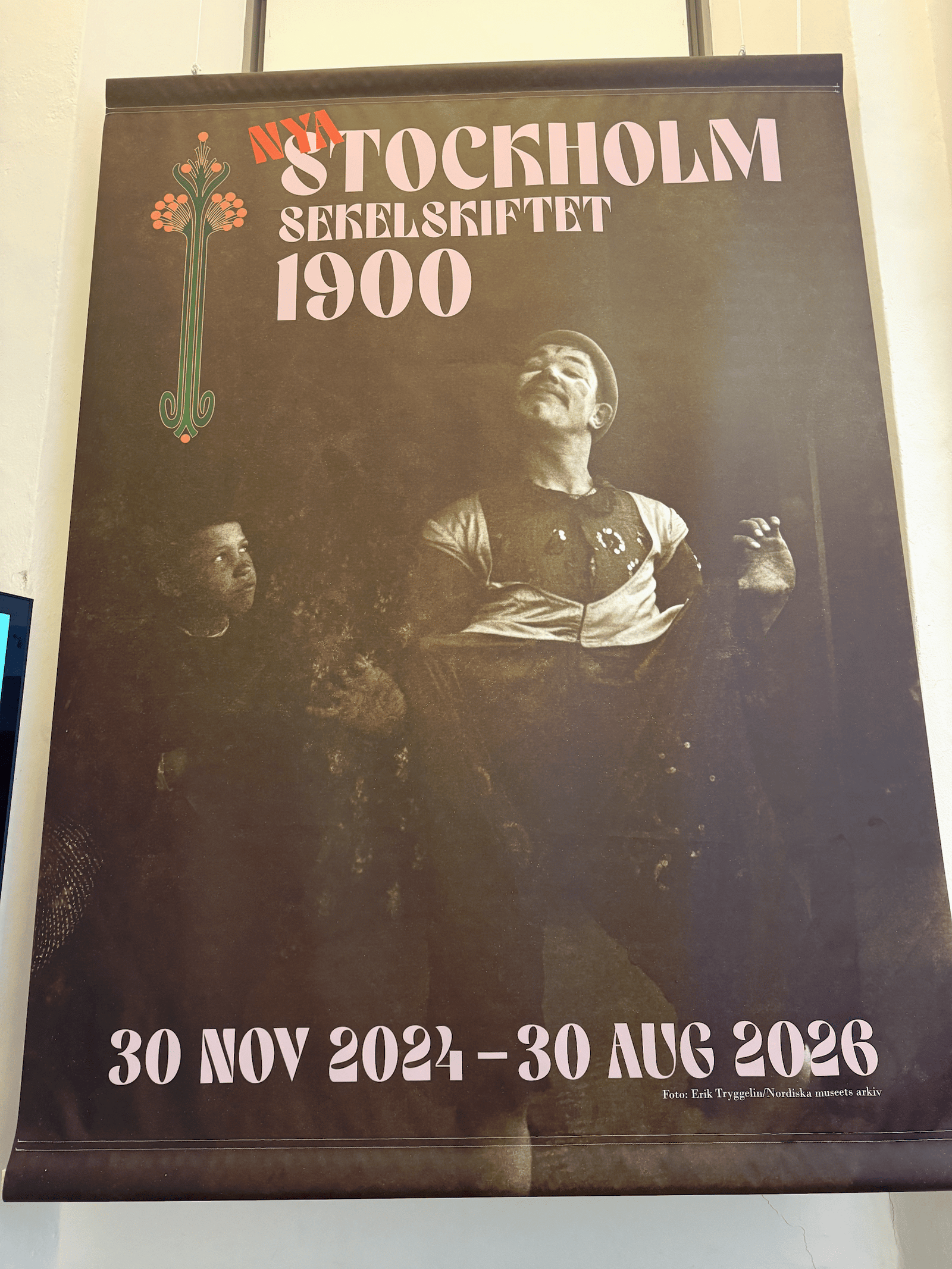
🎟️ Free admission🗓️ Turn-of-the-century exhibition: 30 November 2024 – 30 August 2026
Closing Reflection
Cities are not only built from stone and steel.They are shaped by decisions made under pressure — and by the people who live with the consequences.
Stadsmuseet captures this process with precision and restraint. Walking through these timelines is not just an encounter with Stockholm’s past; it is a way of understanding the city you are standing in today.