Stalheim, Norway: History, WWII Controversy & How to Visit the Most Dramatic View in Western Norway
Stalheim sits above one of Norway's most dramatic valleys — with a history spanning royal postal roads, Kaiser Wilhelm, Nazi occupation, and UNESCO heritage. Here's everything you need to know.
NORWAYSITES TO VISITTOUR GUIDE
Zayera Khan
8/19/20256 min read
Stalheim: Norway's Most Dramatic Viewpoint
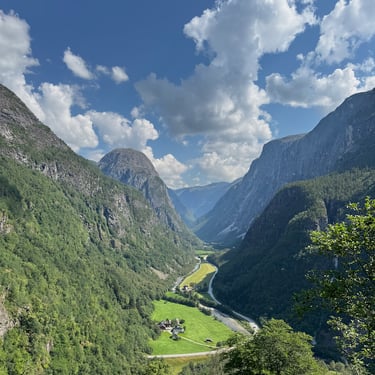
Imagine standing at the edge of a valley so steep, so green, so improbably beautiful that you wonder for a moment whether it's real. That is Stalheim. Perched above the Nærøydalen valley in Western Norway, it offers one of the most photographed views in the country — and one of the most layered histories. It is a place where transport history, national romanticism, wartime collaboration, and UNESCO-listed wilderness all occupy the same few square kilometres.
A Crossroads Before Tourism Existed
Long before anyone used the word tourism, Stalheim was essential. By the 1600s, the Royal Postal Road running between eastern and western Norway passed through here, and local farmers earned vital income as coachmen — transporting mail, goods, and travellers across the mountain passes between Oslo and Bergen.
It was a lifeline in both directions. The road connected isolated communities to the political and intellectual centres of Norway, and eventually to the wider world beyond. The mountains here were not a barrier. They were the route.
The Hotel, the Kaiser, and the View
The drama of the location made an inn inevitable. The first Stalheim Hotel opened in 1885, and it became famous almost immediately — not just among Norwegian travellers but across Europe. The reason was simple: the view over the U-shaped, glacier-carved Nærøydalen valley is extraordinary in a way that photographs only partially capture.
Its most devoted repeat guest was Kaiser Wilhelm II of Germany, who visited Norway nearly every summer between 1891 and 1914, regularly staying at Stalheim. That a German emperor chose this spot as his annual retreat tells you something about what the place meant to a certain kind of European imagination at the turn of the century: wild, sublime, and thoroughly worth the journey.
The hotel has burned down and been rebuilt multiple times over the decades. What stands today is a modern structure, but it occupies exactly the same position above the valley — which is, of course, the whole point.
The Road Down: Stalheimskleiva
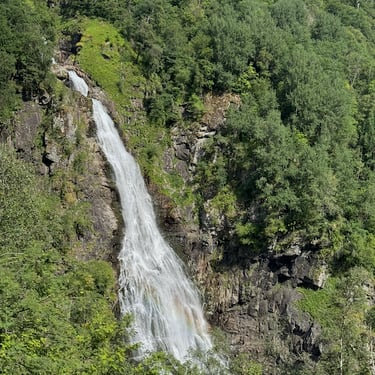
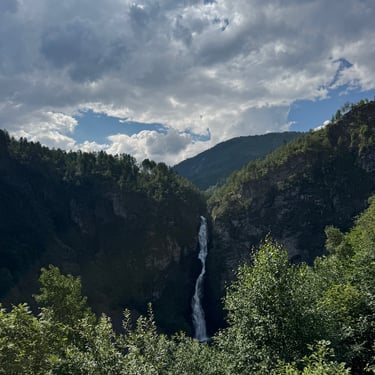
To reach Stalheim, travellers had first to conquer the Stalheimskleiva — a serpentine road of 13 sharp hairpin bends descending 1.5 kilometres, flanked on both sides by waterfalls. Stalheimsfossen drops 126 metres on one side; Sivlefossen drops 240 metres on the other.
Originally a steep bridle path, the road was rebuilt in the 1840s into a proper carriageway with masterfully constructed stone walls. Contemporary observers called it one of the great works of Norwegian road construction. An 1851 traveller captured the experience with memorable honesty: looking down made you dizzy, looking up made you shudder — and yet, somehow, you felt entirely safe.
Since 2021, the historic road has been closed to private vehicles — a decision that has actually improved the experience considerably. Walking or cycling the Stalheimskleiva today, with the waterfalls beside you and the valley opening below, is one of the finest things you can do in Western Norway.
Art, Photography, and the Idea of Norway
From the 1820s onwards, Stalheim became one of the most painted and drawn motifs in the country. Artists came here to capture the sheer valley walls, the particular quality of the light, and the sense of Norway as something pure and untouched. By the 1860s, photographers had joined them, selling images across Europe that drew ever more visitors in return. This was the Romantic ideal in action: wild nature as national identity. What the artists and their audiences conveniently overlooked — or romanticised away — was that Nærøydalen had always been a working cultural landscape. The farms, roads, and stone walls were not interruptions to the scenery.
Per Sivle: The Poet Who Grew Up Here
Stalheim was the childhood home of Per Sivle (1857–1904), one of Norway's national poets. Growing up in the valley shaped everything about his writing — the landscapes, the folk traditions, the quiet lives of ordinary people in extraordinary places.
His poetry became part of Norway's cultural nation-building, particularly during the late 19th century push toward independence from Sweden. Den fyrste songen (The First Song) is perhaps his most famous work, but his voice throughout — blending national romanticism with sharp social observation and genuine warmth — helped define what Norwegian literature could be.
The War Years: Stalheim's Darkest Chapter
This is the part that the hotel brochures tend to skip past, and it deserves to be said plainly.
During the German occupation of Norway (1940–1945), the Stalheim Hotel was used by Vidkun Quisling's Nasjonal Samling — the Norwegian fascist party that collaborated with the Nazi regime. The hotel hosted NS gatherings and became associated with the occupiers in a way that left a lasting shadow over its reputation.
Quisling himself, whose name became a byword for collaboration in virtually every European language, was closely connected to the hotel during the war years. The same building that had welcomed Kaiser Wilhelm and inspired national poets now served as a meeting place for those who had chosen collaboration over resistance.
Norway's reckoning with this period has been ongoing and, in many places, incomplete. Stalheim is not unique in this — dozens of grand Norwegian hotels, estates, and institutions were requisitioned or willingly offered to the occupation. But the contrast at Stalheim is particularly sharp: a place built on the ideals of Norwegian independence and romantic nationalism, temporarily given over to the people who had extinguished that independence by force.
Today the hotel acknowledges this history. It is worth holding in mind when you stand at the viewpoint and look out over the UNESCO valley below.
UNESCO and the Tension of Mass Tourism
The Nærøydalen valley received UNESCO World Heritage status in 2005 as part of the West Norwegian Fjords listing — one of the most celebrated natural and cultural landscapes in Europe. The designation brought international attention, visitor numbers, and a set of obligations around conservation that the region is still actively managing.
Stalheim sits at the intersection of a landscape that the world wants to see and a community that needs to live in it. The closure of Stalheimskleiva to private vehicles was one response. The ongoing debate about cruise ship traffic on the Nærøyfjord below is another. There are no easy answers, but it is worth being a thoughtful visitor — which mostly means slowing down, walking when you can, and spending your money locally.
Hiking Around Stalheim
The area around Stalheim is genuinely excellent walking territory, with routes that suit everything from a gentle hour to a full day in the mountains.
Stalheimskleiva on foot is the obvious starting point — walk down the historic hairpin road with the waterfalls beside you. Allow around 30–45 minutes each way and take your time at the bends. The stone walls alone are worth stopping for.
The Royal Postal Road (Kongevegen) runs through the valley below and can be walked in sections. Passing old farms, stone bridges, and forest, it is one of the quieter and more atmospheric ways to experience the landscape. The stretch from Stalheim down toward Vinje and Gudvangen is particularly rewarding.
Stalheimsnosi is a mountain viewpoint above the hotel that offers a different perspective on the valley — looking down rather than out. The trail is steep but well-marked and takes around 1.5–2 hours return.
For longer routes, the area connects into the broader network of trails around Voss and the Nærøyfjord — conditions and trail status are best checked at visitvoss.no before you go.
When to Visit
Late May through September is the main season. The valley is at its greenest in June and July, the waterfalls are fullest with snowmelt in late spring, and the light in midsummer is extraordinary — long, golden, and forgiving to photographers.
August and early September offer a slightly quieter experience than peak July, with the added benefit of autumn colours beginning to appear on the valley walls from mid-August onwards.
Outside the main season, Stalheim is stark and beautiful in a completely different way — but the hotel and most services are closed. If you are visiting in winter or early spring, check ahead.
Opening Hours & Practical Details
Stalheim Hotel is typically open from mid-May to mid-September. The hotel restaurant is open to non-guests for lunch and dinner during the season. Check current dates and reservations at stalheim.com.
The Stalheimskleiva (the historic hairpin road) is open year-round for walking and cycling. Closed to private vehicles since 2021.
The Nærøydalen valley and Royal Postal Road are accessible year-round with no admission charge.
How to Get There
By car: Stalheim is located off the E16 between Voss and Gudvangen. Turn off at the signed junction and follow the road up to the hotel. The drive from Bergen takes around 2 hours; from Oslo, around 5 hours.
By public transport: Take the Bergen–Oslo train to Voss, then connect by bus toward Gudvangen (Skyss route 990 or similar — check current schedules at skyss.no). Get off at the Stalheim junction and walk up, or check whether the hotel offers transfers during the season.
By fjord: Arriving by boat along the Nærøyfjord from Gudvangen and then traveling up through the valley by road is one of the most memorable ways to approach Stalheim — from below, with the full scale of the landscape revealing itself gradually.
Stalheim rewards the kind of travel where you arrive with time and leave with questions. The view is as good as the photographs suggest. The history is more complicated than the brochures admit. And the walk down the old hairpin road, with the waterfalls loud beside you and the valley opening below, is one of those experiences that stays with you long after the journey home.
Stalheim is located in Voss municipality, Vestland county, Western Norway. The nearest large town is Voss, approximately 35 km away.