Sofia, Bulgaria: What Europe's Most Underestimated Capital Is Really Like
A travel guide to Sofia, Bulgaria — free walking and food tours, cheap metro, queer nightlife, vegetarian food, and the social realities behind the beautiful facades. Facts, tips, and personal impressions from a recent visit.
BULGARIASITES TO VISIT
Zayera Khan
4/9/20265 min read
A travel guide to Sofia — free walking and food tours, cheap metro, queer nightlife, vegetarian food, and the social realities behind the beautiful facades.
Sofia kept coming up as a stopover, a layover, a "well, it's cheap" destination. I'd heard it described as rough around the edges, post-communist, still figuring itself out.
Section 1 — Bulgaria and Sofia: the facts
Bulgaria is a country of about 6.4 million people (2024), located in southeastern Europe. It borders Romania to the north, Serbia and North Macedonia to the west, Greece and Türkiye to the south, and the Black Sea to the east. At its population peak in 1987, the country had nearly 9 million people. It has since lost over 2.2 million — a 27.5% decline — driven by low birth rates and sustained emigration. The median age is 45, one of the highest in Europe.
Ethnically, approximately 85% of the population is Bulgarian. The two largest minority groups are Turkish (8.8%) and Roma (4.9%), alongside around 40 smaller minorities. The Roma community has a poverty rate recorded at over 60%, compared to around 5–6% among ethnic Bulgarians — a gap that reflects decades of structural exclusion and poor access to education. Hate speech targeting Roma, Muslims, and migrants has been rising, with nationalist politicians playing a documented role.
Bulgaria ranked 55th globally on the Human Development Index in 2023 — classified as "very high human development." Tourism to Sofia grew 10% in 2024.
Sofia is the capital and by far the largest city, with a population of over 1.2 million. It sits at 550 metres above sea level on the Sofia Plain, with Mount Vitosha rising immediately to the south. The city has been continuously inhabited for around 2,000 years — first as the Thracian settlement of Serdica, then as a Roman city, then under Byzantine, Bulgarian, and Ottoman rule, before becoming the capital of the modern Bulgarian state in 1879.
Section 2 — What I saw: Sofia through the photos
The symbol of the city
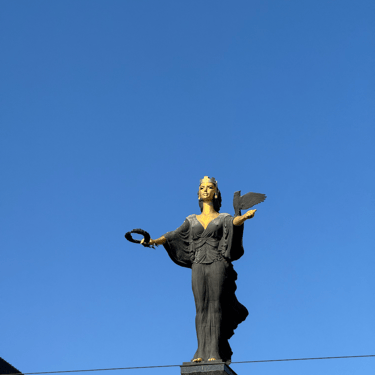
The Statue of Sofia stands at the intersection of the city's main streets — a bronze woman on a tall column, holding an owl (symbol of wisdom) on one arm and a laurel wreath (symbol of glory) in the other, with a crown of towers on her head. Installed in 2001, she replaced a statue of Lenin that stood in the same spot during the communist era. The city itself is named after the Hagia Sophia church, not after her — but she has become the city's most recognised emblem.
The layering of 2,000 years
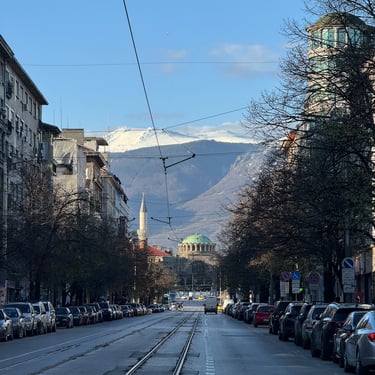
One boulevard shot taken near the city centre captures what makes Sofia visually unlike most European capitals: tram tracks running down the centre of the road, a mosque minaret rising to the left, the golden dome of Alexander Nevsky Cathedral visible further back, and snow-capped Mount Vitosha closing the frame at the end of the street. Four distinct eras of the city in a single frame.
Vitosha is at 2,290 metres and is visible from most of the city centre. It functions as a constant geographical anchor.
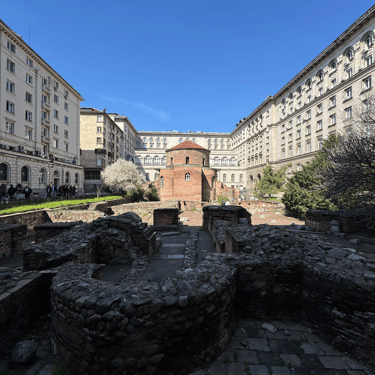
The oldest surviving structure in the city centre is the St. George Rotunda — a 4th-century Roman brick church, still standing in an open courtyard surrounded by Roman-era ruins, hemmed in on three sides by Soviet-era government buildings. The contrast is not subtle.
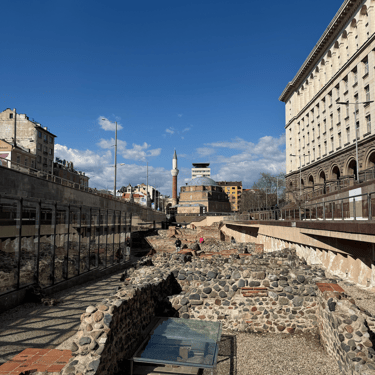
The ancient Roman city of Serdica lies partly visible beneath the streets. Excavated ruins are on open display in the city centre, with the Banya Bashi Mosque minaret rising directly behind them — another compressed layer of history on a single site.
The Mineral Baths
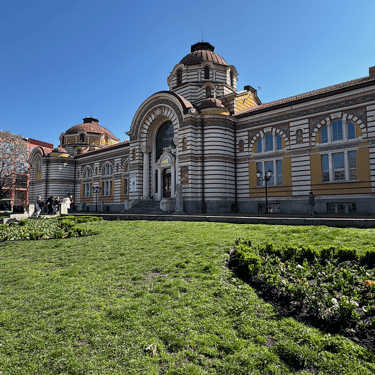
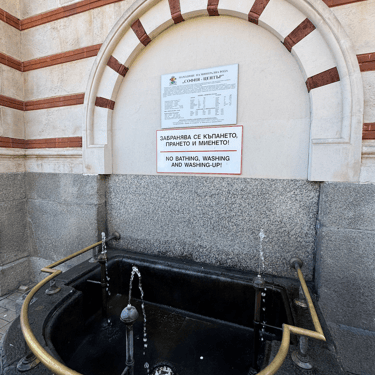
The Central Mineral Baths is a large yellow and cream ornate building from the early 1900s, now housing the Sofia History Museum. Outside it, public thermal water taps have been in continuous use since Roman times. The water is warm and slightly sulphurous. Locals fill bottles here daily.
Places of worship — four within walking distance
Within a few minutes of each other in the city centre: the Banya Bashi Mosque (Ottoman, 16th century), the Sveta Nedelya Cathedral (Orthodox, rebuilt 1933 after a 1925 bombing), the Russian Church of St. Nicholas (Russian Orthodox, 1914), and the Sofia Synagogue (1909, one of the largest in Europe).
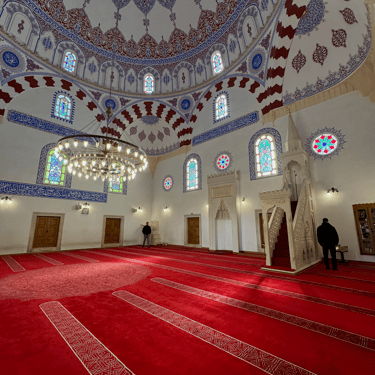
The interior of Banya Bashi Mosque has a white dome with red and blue geometric painted detail, a deep red carpet across the full floor, and stained-glass windows on all sides. It was built between 1474 and 1576 and is the only functioning mosque in Sofia.
I was raised Muslim — lapsed, complicated. Walking into a mosque in an unexpected city is always a specific experience.
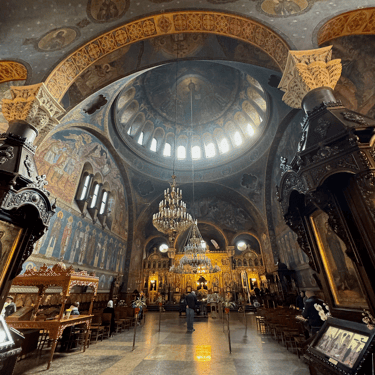
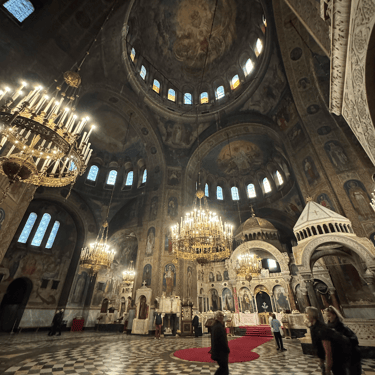
Sveta Nedelya Cathedral has a fully frescoed interior — walls and domes covered in Orthodox iconography, a large gold iconostasis at the altar end, and multiple chandeliers. It was rebuilt after being destroyed in the 1925 anarchist bombing that killed 150 people.
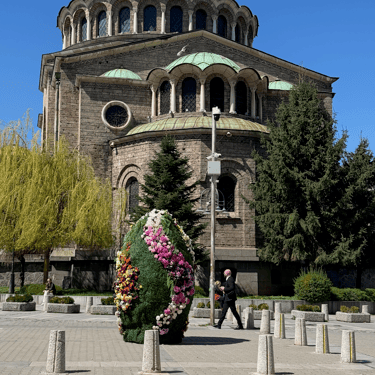
Outside Sveta Nedelya in early April: a large Easter egg sculpture made of flowers had been installed in the square in front of the church, alongside the blossoming of a weeping willow. The Orthodox Easter calendar placed Easter two weeks after the Catholic date this year.
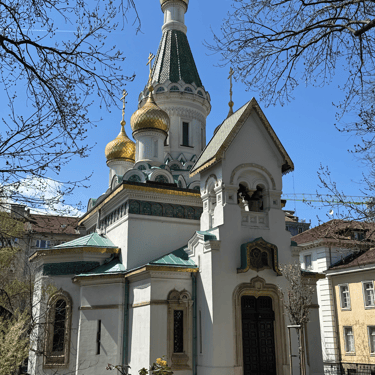
The Russian Church of St. Nicholas, built in 1914 for the Russian diplomatic community, has five golden onion domes. It is compact, easy to walk past, and one of the most photographed buildings in the city.
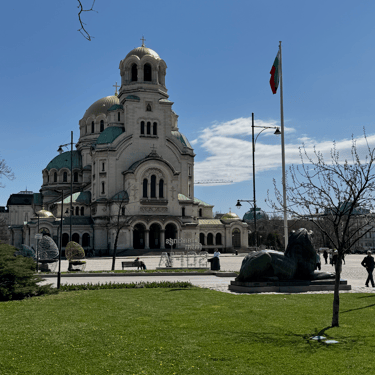
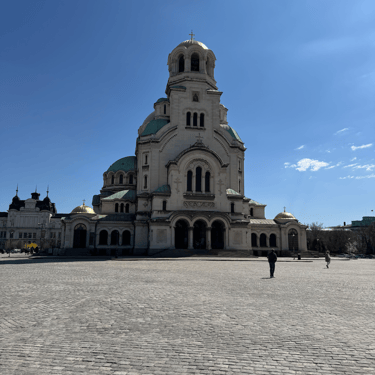
Alexander Nevsky Cathedral is the largest Eastern Orthodox cathedral in the Balkans — built between 1882 and 1912 to commemorate the Russian soldiers who died in the Russo-Turkish War of Liberation (1877–78). The exterior has green copper domes and a central gold dome visible from across the city. The interior spans 3,170 square metres, with a black-and-white marble floor, multiple large chandeliers, and walls and ceilings covered in frescoes.
Soviet-era Sofia
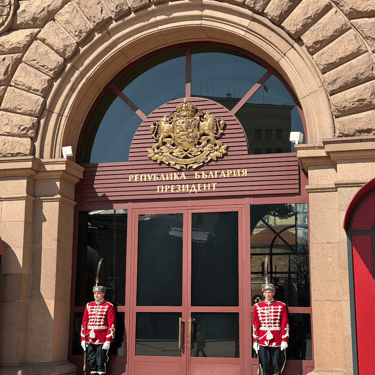
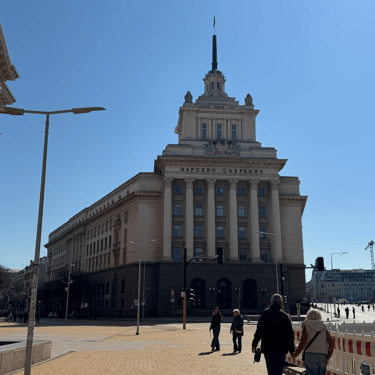
The Largo is a monumental Soviet-era ensemble in the city centre — three connected government buildings in the Stalinist classical style, built in the 1950s. The central building houses the National Assembly (parliament). The Presidential Palace, with its ceremonial guards in red uniforms, sits immediately adjacent.
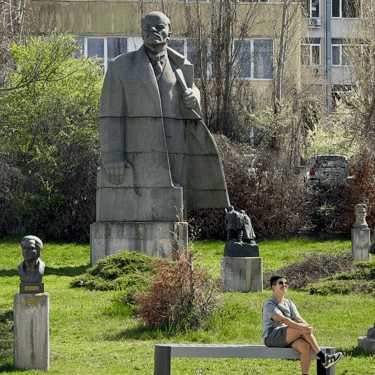
The Museum of Socialist Art, behind the National Gallery, holds an outdoor sculpture garden of socialist realist works removed from public spaces after 1989. Among them: a large seated Lenin.
Street life and public space
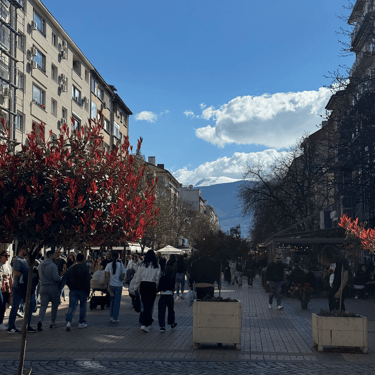
Vitosha Boulevard is the main pedestrian street, running south from the city centre toward the mountain. In early April it was busy — cafés with outdoor seating, street vendors, locals and tourists in the same space. Mount Vitosha is visible at the far end of the street.
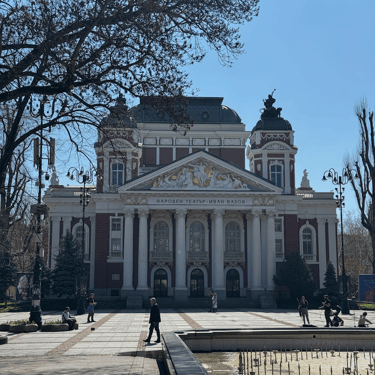
The National Theatre (Ivan Vazov National Theatre, built 1906) is a neo-baroque building at the edge of the City Garden — cream and terracotta, with statues along the roofline. The City Garden in front of it has benches and bronze statues.
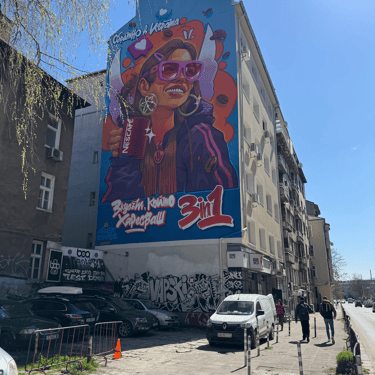
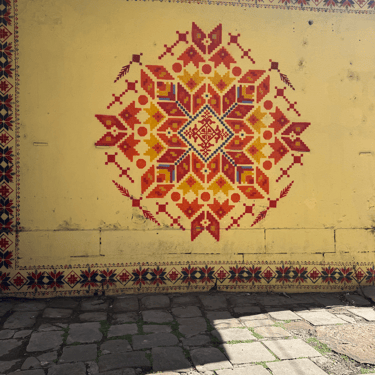
Sofia's street art is large-scale. A pop-art portrait covers the full side of a building near the centre. A second mural uses Bulgarian folk embroidery patterns — geometric red and gold on yellow — across an entire wall. Both are in the Lozenets/city centre area.
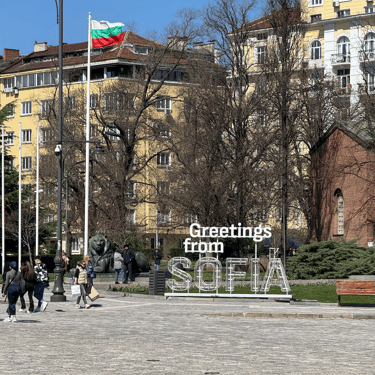
The "Greetings from Sofia" sign sits in the square near the National Assembly, with the Bulgarian flag and the St. Sofia Basilica visible behind it.
Spring: the martenitsi
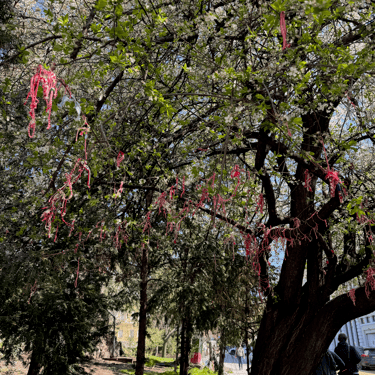
In early April the martenitsi tradition is visible everywhere. Martenitsi are small red-and-white woven ornaments exchanged on the 1st of March — Baba Marta Day. The tradition is to wear one until you see the first stork or the first blossoming tree of spring, then tie it to a branch. By April, certain trees in Sofia are covered in them.
Food
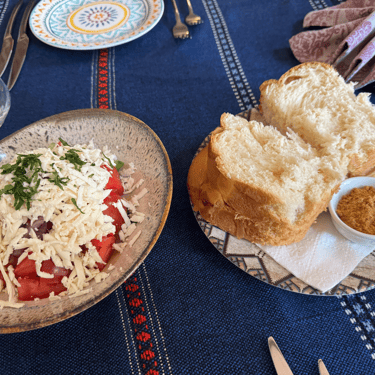
Bulgarian food is bread, cheese, grilled meat, slow-cooked stews, and fresh vegetables — generous portions, generally affordable. The shopska salad — tomato, cucumber, and grated white sirene cheese — is on every traditional menu.
For plant-based eating, Edgy Veggy is the main option — well-priced, popular, near the centre.
Borisova Gradina
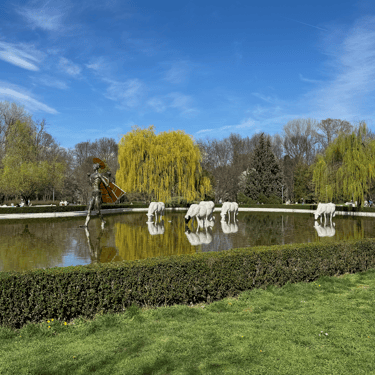
Borisova Gradina is the main city park, on the eastern edge of the centre. It has an open-air sculpture area, a large pond with white horse sculptures at the water's edge, and wide paths used by runners, dog walkers, and families. Entry is free.
Getting around
The city centre is compact and flat — most sites are within walking distance of each other. The metro is cheap by European standards. The Visit Sofia tram runs a hop-on, hop-off tourist route.
What the city doesn't conceal
There are people sleeping on the streets in the city centre. Poverty is visible alongside the restored landmarks and the café culture. Sofia's contrasts are not hidden.
Photos taken in Sofia, Bulgaria, April 2026.