
Harriet Backer: The Norwegian Painter Who Mastered Light — and Changed Everything
Harriet Backer (1845–1932) turned ordinary rooms into extraordinary paintings — and spent her whole life refusing to live by other people's rules. Here's why she deserves far more attention than she gets.
NORWAYART
Zayera Khan
8/19/202515 min read
Harriet Backer: The Woman Who Painted Light From the Inside Out
I want to tell you about a woman most people outside Scandinavia have never heard of, even though she was one of the finest painters of her era and spent decades shaping what Norwegian art looked like. Her name was Harriet Backer, she was born in 1845, and she died in 1932 having lived almost entirely on her own terms. She never married, she studied in Munich and Paris when women were barely tolerated in the academies, she opened her own painting school and ran it for over twenty years, she sat on national juries and acquisition committees, and she produced a body of work that a major retrospective in 2023 brought to over 600,000 people across Europe — the first international exhibition of her work since 1925. That's a hundred years of relative silence about someone of this calibre, and that silence is worth thinking about.
But let's start with the paintings themselves, because they are genuinely something else.
What She Was Doing With Paint
Backer spent most of her career painting interiors. Rooms. The kind of rooms that women spent their lives in — sitting rooms, parlours, churches, small domestic spaces where a woman might be reading or playing piano or just existing quietly. These were not considered prestigious subjects in 19th century art. The hierarchy of genres placed history painting and classical figures at the top, landscape somewhere in the middle, and domestic interiors somewhere near the bottom — which is not a coincidence, given that interiors were associated with women's lives and women's lives were considered aesthetically minor.
What Backer did inside those rooms, though, was extraordinary. She developed what she called her version of en plein air painting brought indoors — meaning she painted directly in front of her subject, in the actual space, in the actual light, observing in real time how light moved and shifted across walls and ceilings and faces. She wasn't approximating from sketches or memory the way many painters did. She was watching. The light in a Norwegian interior in winter is not the same as in summer, and morning light behaves completely differently from afternoon light, and she paid attention to all of it with unusual patience and precision.
The results are paintings that make you feel like you've just quietly entered a room. The Norwegian art critic Andreas Aubert saw one of her works in 1883 and wrote that every atom was colour. That phrase followed her for the rest of her life, and it's accurate — her interiors have a quality that's almost musical, where nothing is static and even the shadows feel alive.
The World She Was Born Into — and What That Actually Meant
Harriet Backer was born into a comfortable merchant family in Holmestrand, a small coastal town south of Kristiania, which is what Oslo was called then. Her household was cultured and financially stable, which mattered enormously. I want to be honest about this, because the story of women "breaking barriers" in the 19th century is almost always also a story about class. Working-class women were not travelling to Munich to study painting. Backer had options that the vast majority of Norwegian women simply did not have, and that structural privilege is part of how she was able to do what she did.
That said, privilege can only take you so far. The art world she entered was built by and for men — its academies, its exhibition systems, its critical networks, its purchasing committees. Women were permitted at the edges. To move to the centre, as Backer eventually did, required relentless work over decades. She studied in Munich from 1874 to 1878, then in Paris until 1888, which is fifteen years of serious training in the parallel structures that women had carved out for themselves because the formal institutions mostly wouldn't have them. When she returned to Norway she founded her own painting school in Kristiania in 1889 and ran it until 1912. Twenty-three years. Some of the most significant names in Norwegian modern painting came through that school, including Nikolai Astrup, whose work is now celebrated internationally.
She also sat on exhibition juries and acquisitions committees for the Norwegian National Gallery — positions rarely given to women at the time. She used them. She wasn't waiting to be included in the canon. She was working from inside the institution to change what it valued, which is a different strategy and, honestly, probably a more effective one.
A Family of Remarkable Women
Harriet was not the only extraordinarily talented person in her family. Her younger sister Agathe Backer-Grøndahl, born in 1847, became one of the most celebrated Norwegian composers and pianists of her era — admired by Edvard Grieg, praised by Brahms, a genuinely major figure who has also been substantially underrepresented in the European musical canon, for the same reasons Harriet was underrepresented in the art historical one. Two sisters, two fields, two careers of exceptional quality, both partially recovered by contemporary scholarship after decades of relative neglect. There is something very recognisable about that pattern.
Music runs through Harriet's paintings in a way that is impossible to separate from that sibling bond. Many of her most celebrated interiors feature a woman absorbed at the piano. Agathe appears in several of them, or at least her presence does — you feel it in the quality of attention. When Kode in Bergen mounted a concert series of Agathe's compositions alongside Harriet's retrospective exhibition, it wasn't a decorative touch. It was restoring a relationship that Harriet had woven into the work from the beginning.
Kitty Kielland and the Friendship That Shaped a Life
The most important relationship in Harriet Backer's adult life — personally and professionally — was with the painter Kitty Kielland, who was born in 1843 and died in 1914. They met while studying in Munich in the 1870s. They overlapped in Paris. They came back to Norway and became, together, two of the most significant voices in Norwegian art and two of the most committed advocates for women's access to artistic training and professional recognition. They shared exhibitions and causes and decades of working life in a field that had not been designed with either of them in mind.
What their relationship actually was in private is something history has not preserved clearly, and I think that gap deserves more than a quick reassurance that they were "close friends." We know they were deeply connected over a very long time. We know Backer never married. We know she built her world around her work, her students, and this friendship, and that she was evidently not interested in the domestic life that Norwegian society in the 1870s considered the natural destination for a woman of her class.
Was She Queer?
This question comes up more now, and I think it deserves a genuine response rather than a deflection.
There is no surviving documentation — no letters, no diary entries, no contemporary accounts — that identifies Backer as a lesbian or describes a romantic relationship between her and Kielland, or anyone else. By the usual evidentiary standards, her private life stays private.
But I think it's important to be clear about what that absence of documentation actually tells us, because it doesn't tell us much. In late 19th century Norway, a woman who loved another woman had every practical reason to be careful. The language available for deep attachments between women was the language of "romantic friendship" — a register that was socially acceptable precisely because it could cover a very wide range of actual experience without naming it. Discretion wasn't paranoia; it was just how you survived. Queer history is, disproportionately, a history of absences — of letters that were burned, of relationships named only in language designed not to be read too directly, of lives that were legible to the people who lived them and illegible to the archives that came after. The absence of evidence is not evidence of absence, particularly for women of this period.
What I can say plainly is that Harriet Backer lived outside the expected script. She didn't seek a husband or the social legitimacy that came with one. Her most sustained personal bond was with another woman artist. She constructed a life on entirely her own terms for nearly nine decades. Whether that makes her queer in the modern sense is a question each person will answer for themselves. What it unquestionably makes her is someone who refused to live a life that didn't fit her, at a time when that refusal cost something real.
What She Was Actually Painting — and Why It Was Political
I want to come back to the interiors for a moment, because there's something worth saying about the choice of subject that goes beyond technique.
In the critical hierarchy of 19th century European art, domestic interiors were a lesser genre. And they were a lesser genre precisely because they were associated with women's spaces and women's lives. The places where women spent most of their time — the home, the church, the parlour — were aesthetically marginal because women's lives were considered marginal. To paint those spaces brilliantly, insistently, across an entire career, and to find in them the same complexity and depth and light that other painters were seeking in landscapes and historical subjects, was making an argument. Whether Backer made it consciously matters less than the fact that she made it. She looked at the spaces women inhabited and said: this is where the light is.
Later in her career she turned increasingly to church interiors, and the same logic applies. These were spaces where women were present but not powerful — attendees, witnesses, not officiants. Backer painted the experience of being there with the same unflinching care she brought to everything else. Works like Interior from St. Mary's Church and her paintings of Tanum Church and Uvdal Stave Church are among the most quietly powerful things she made. The light in those spaces carries age and silence and something else that is hard to name. She was a believer, but her church paintings were never about doctrine. They were about the particular quality of light that comes through old stone, and the people who were actually there.
Why She Disappeared — and Why She's Back
Art history, like most history, was written primarily by men about men. The canon — the list of names considered essential, the artists whose work gets reproduced in textbooks and hung in permanent collections — reflects the tastes and blind spots of the people who built it. A woman could be celebrated in her own lifetime and still vanish from the record within a generation. Backer was celebrated in her lifetime. She exhibited widely, received strong critical reviews, trained major artists, sat on national committees. And then she became a footnote. The retrospective Every Atom is Colour — which toured Oslo, Stockholm, Paris, and Bergen between 2023 and 2025 and was seen by over 600,000 people — was the first major international exhibition dedicated to her since 1925. A hundred years. For one of the finest painters Norway ever produced.
That is not an oversight. It is a pattern, and it repeats across nearly every field. Women who achieved genuine significance in their own time got gradually written out as the men who came after them consolidated control of what counted as the canon. The fact that Harriet Backer is being recovered now, alongside her sister Agathe, is part of a much larger and genuinely necessary reckoning with whose work was kept and whose was quietly set aside.
See Her Work
The full tour of Every Atom is Colour:
National Museum, Oslo — September 2023 to January 2024 Nationalmuseum, Stockholm — February to August 2024 Musée d'Orsay, Paris — September 2024 to January 2025 Kode Art Museum, Bergen — February to August 2025
The exhibition has now concluded its international tour. Backer's permanent collection is held primarily at the National Museum in Oslo and at Kode in Bergen. The exhibition catalogue, published by Hirmer Verlag in English and Norwegian, is available online and genuinely worth having if you want to spend more time with the paintings. For any future exhibitions or touring dates, check nasjonalmuseet.no and kodebergen.no.
Harriet Backer spent sixty years looking very carefully at the light in ordinary rooms and finding, again and again, that it contained everything worth painting. There is something in that refusal to consider the domestic and the feminine as lesser — and to insist, through the work itself, on its depth — that feels as relevant now as it was radical then. She didn't write manifestos. She painted rooms. And she proved, atom by atom, that they were full of colour.
The Paintings I Couldn't Walk Past: Twenty Works That Stopped Me
I didn't go to the Every Atom is Colour retrospective expecting to be undone. I went as a traveller interested in Nordic cultural history, and I left as someone who had been quietly taken apart and reassembled. These are the twenty paintings that did it — and why I think they matter far beyond the walls of any museum.
The Interior as Political Statement
The image most people associate with Harriet Backer is the domestic interior. A woman sewing. A woman at the piano. A woman bent over her work in a lamplit room. It would be easy — and wrong — to read these as modest, small subjects. Backer's interiors are radical precisely because of how seriously she took them.
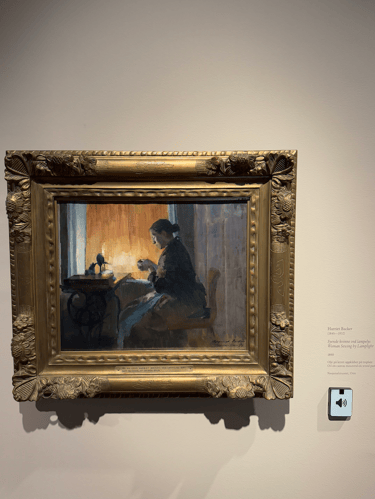
Woman Sewing by Lamplight (1890, Nasjonalmuseet, Oslo) is the painting I keep returning to. A single figure in silhouette, a candle burning beside her, the warm amber of the flame pushing back against the cold blue at the window. Backer does something technically astonishing here: she treats the light itself as the subject. The woman is almost secondary to the physics of illumination happening around her. But then you look again, and you realise the woman is the light — her stillness, her absorption in the work, is the source of everything radiant in the frame.
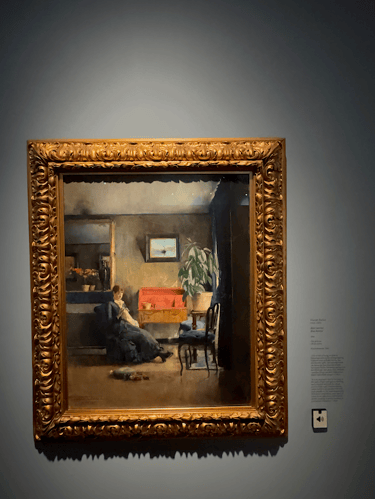
The same quality is present in Blue Interior (c. 1881, Rasmus Meyer Collection, Bergen), one of Backer's earlier and undersung works. A figure in a dark dress sits absorbed in a room that glows with cool northern light. Backer was obsessed with the particular quality of Scandinavian daylight — its horizontal angle, its tendency to pool and gather rather than flood — and this painting shows her already mastering that language before she had her Paris training behind her.
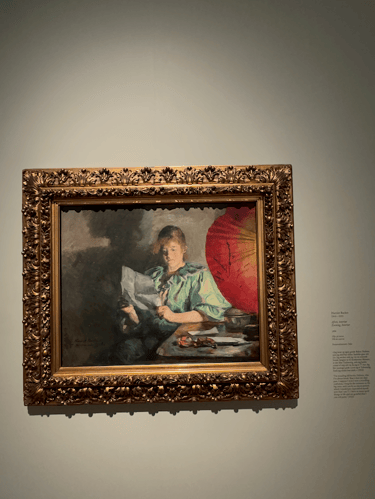
Evening Interior (1890, private collection) pushes further still. The red Japanese parasol in the background — a vivid, almost shocking note — frames the reading woman in a way that feels deliberately composed, a woman who has chosen her surroundings, who inhabits her space with full intention. These are not passive subjects. They are women who own their rooms.
Music as a Through-Line
Backer herself was a trained pianist and close friend of the composer Agathe Backer Grøndahl — no accident of surname; they were siblings. Music runs through her work not as backdrop but as a preoccupation. She painted pianos the way other artists painted rivers.
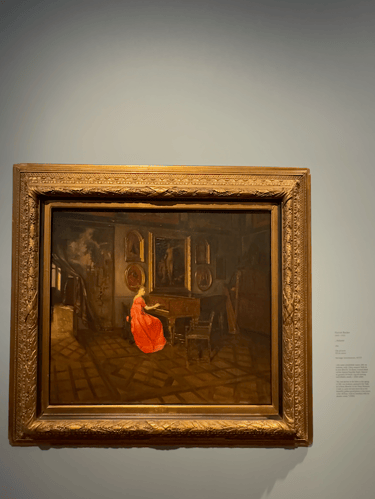
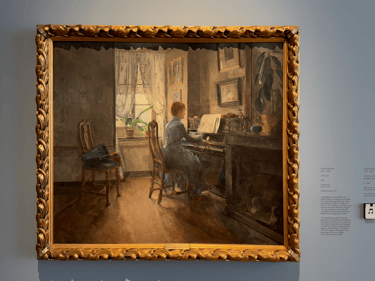
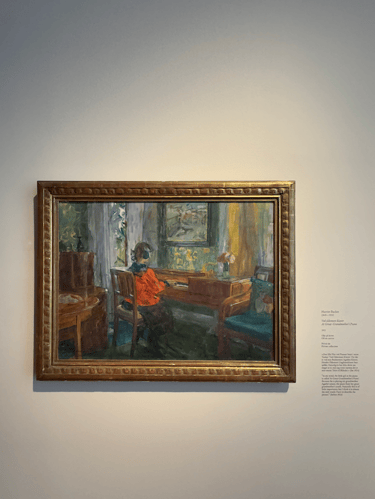
Chez moi (1887, Nasjonalmuseet, Oslo) is perhaps her finest piano painting. A woman seated at the instrument, back to us, the room pressing in around her with all its careful accumulation of objects — a rubber plant, framed pictures, the window's diffuse light. Backer wrote about this painting while making it, describing how the light from the window made it impossible to see the figure and the piano at the same time. Her solution was to make that tension the point. The painting holds two focuses simultaneously and refuses to resolve them.
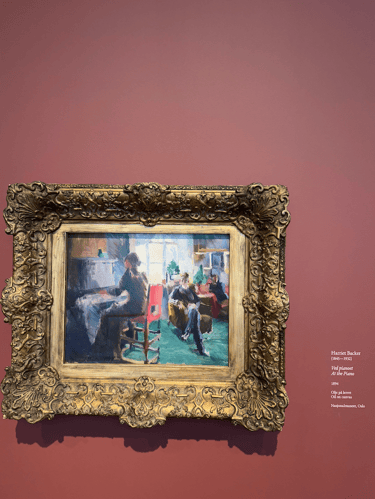
At the Piano (1894, Nasjonalmuseet, Oslo) is smaller and looser — a sketch-like energy to it, multiple figures gathered near the instrument, the room alive with conversation or listening. Where Chez moi is a meditation, At the Piano is a social document.
The most poignant of the music paintings is At Great-Grandmother's Piano (private collection), in which a child in a bright orange top sits at a large old instrument in a room scattered with afternoon light. The scale disparity between the child and the piano is almost architectural. There is something about it — the inheritance of music, the way a piano sits in a family for generations — that makes this painting feel like a memory of a memory.
Rural Norway and Working Women
Backer did not limit herself to the bourgeois drawing room. Some of the most important works in the retrospective show working women in rural and agricultural settings, observed with the same unflinching attention she brought to her Kristiania interiors.
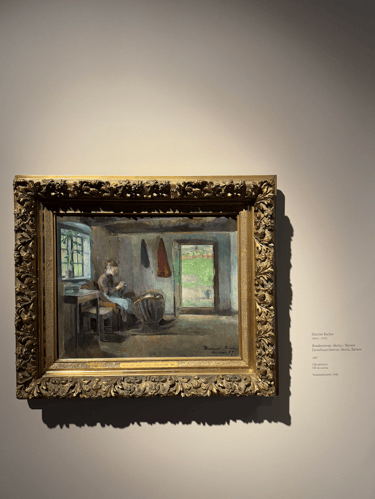
Farmhouse Interior, Skotta, Bærum (1887, Nasjonalmuseet, Oslo) shows a woman alone at a table by a window, a basket beside her, an open door through which the green of a summer field is visible. Backer catches the double light — the window on the left, the doorway at the back — with a precision that is almost architectural. The room breathes.
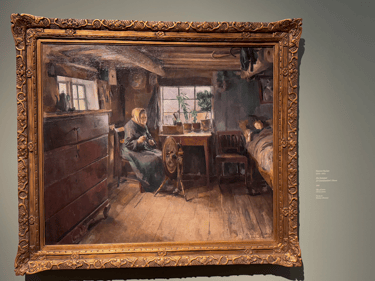
At Grandmother's House (1888, private collection) is a masterwork of layered light. An old woman at a spinning wheel, a child asleep in a bed to the right, the room full of the accumulated objects of a long life. Backer is interested in duration here — the time it takes to spin, the time it takes to sleep, the deep time stored in old furniture and worn floorboards.
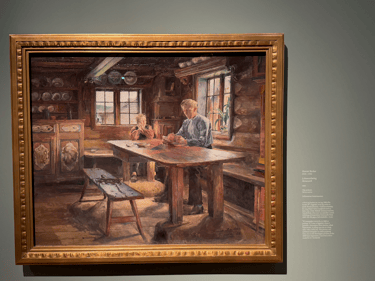
Homework (1888, Lillehammer Art Museum) shows a man and child at a heavy rural table, the room warm with wood tones and the light of two windows. The man's pale hair is the brightest note in a painting full of brown shadow. It is one of Backer's rare works centred on a male figure, and what strikes me is that it feels entirely continuous with the rest of her practice — the same patient attention to what light does to a body at work.
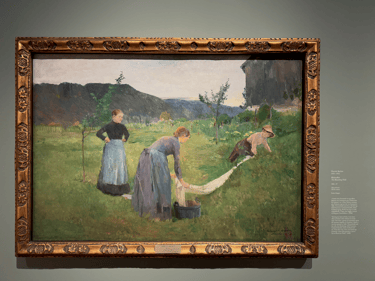
The Bleaching Field (c. 1889, Kode, Bergen) moves outdoors — three women laying and stretching laundry in a wide meadow backed by forested hills. This is collective labour, women working together, and Backer gives it the same compositional seriousness she would give a formal portrait. The cool grey-green of the landscape, the tones of the women's work clothes, the white sheet they are laying out — it is a painting about colour and collaboration simultaneously.
Paris and the Formation of an Eye
Before Backer became the painter of Norwegian interiors, she spent formative years in Paris, studying and absorbing. Two paintings in the retrospective document this period directly.
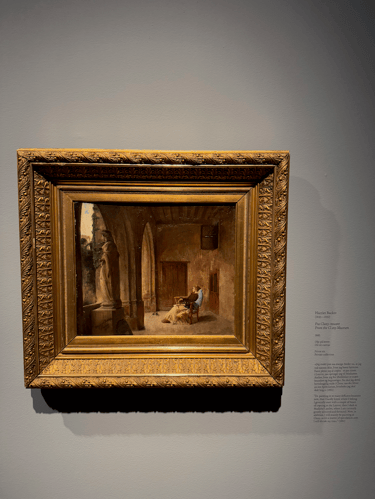
From the Cluny Museum (1885, private collection) is the most surprising work in the show. Backer takes the medieval courtyard of the Hôtel de Cluny — all Romanesque arches, stone, and ivy — and places two small figures in it, a woman and a companion absorbed in looking at something we cannot see. The scale is different from her interiors; the architecture dominates. But the principle is the same: light filtering through stone the way it filters through glass, a human figure as the fixed point that gives the space its scale and meaning.
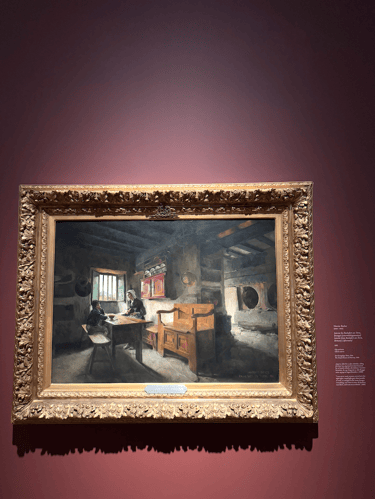
Interior from a Farmhouse in Rochefort-en-Terre, Brittany (1892, National Museum Oslo) is a masterpiece of darkness. Two figures sit at a table in what appears to be an ancient Breton farmhouse, the room so dim that objects emerge slowly — a dresser, hanging pots, a grate. The light from a small barred window falls on the woman in a white cap with a quality that feels almost devotional. Backer was interested in the oldest kinds of domestic space, the rooms that had accumulated centuries of use, and this painting captures that accumulation with almost archaeological patience.
The Church Series: Sacred Space as Interior Problem
Backer returned repeatedly to church interiors throughout her career, and the retrospective gathers enough of these works to reveal them as a sustained artistic inquiry rather than occasional excursions.
What is remarkable about her church paintings is that they do not treat sacred space as transcendent. They treat it as a technical problem: what does this particular quality of light do inside this specific building, and how do the bodies of worshippers inhabit that light?
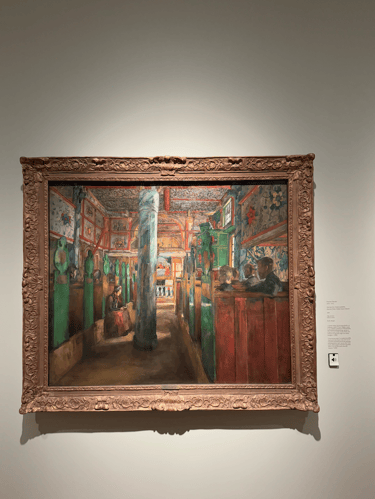
Interior from Øidal Aurdals Kirke is one of the most explosively colourful paintings in the entire show — a Norwegian stave-church interior with painted folk-art decoration covering every surface, columns, ceiling, pews, all in vivid reds, greens, and blues. Against this visual cacophony, a single woman sits reading, and a group of figures in the background confer in low light. The painting is almost destabilising. You cannot look at it calmly.
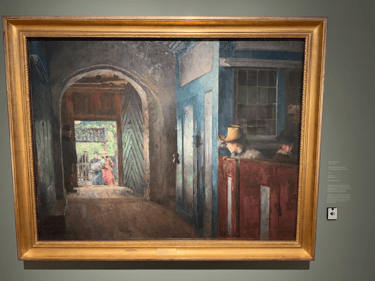
Christening in Tanum Church (1892, Nasjonalmuseet, Oslo) is its compositional opposite: a narrow, dark porch-space, light flooding through an arch from the churchyard beyond, figures silhouetted and gathered at the threshold. Backer is interested here in the liminal — the space between outside and inside, between secular and sacred, the moment before the ceremony begins. It is among her most formally inventive works.
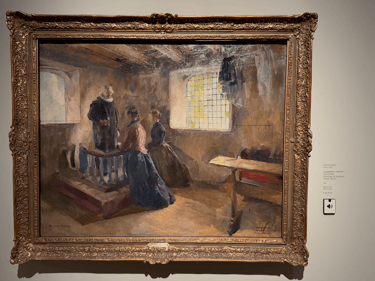
Churching, the Sacristy in Tanum Church (1892, Kode, Bergen) shows a priest receiving a woman in the sacristy after childbirth — the ritual of churching, a tradition of ecclesiastical re-entry after confinement. Backer depicts this with complete matter-of-factness and, in doing so, preserves a practice that has since disappeared. The stained glass window throws green and yellow light into the room. The figures are specific; this is not a generic church scene, it is a record of something that happened.
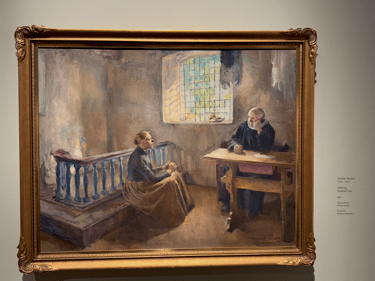
Pastoral Care (1892, private collection) places two figures in a sacristy — a woman seeking counsel, a clergyman receiving her — the room spare, the stained glass window glowing, the composition symmetrical in a way that suggests a conversation between equals. Backer painted this the same year as the Tanum sacristy works, and the relationship between them — the various human transactions that take place in the margins of religious buildings — is one of the most quietly radical aspects of her practice.
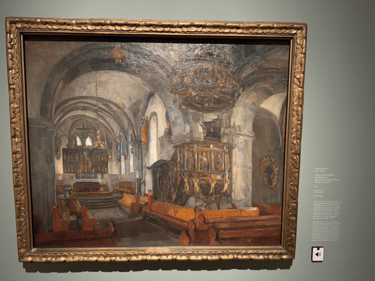
Interior from St Mary's Church, Bergen (1913, Kode, Bergen) is the late masterwork of the church series. The Romanesque nave opens up in all its depth, the chandelier elaborate above the ornate pulpit, light falling through high medieval windows. Backer was in her late sixties when she made this painting, and it has the authority of a career's worth of looking behind every mark. She does not romanticise the space; she renders it.
The Landscape: A Single Horizon
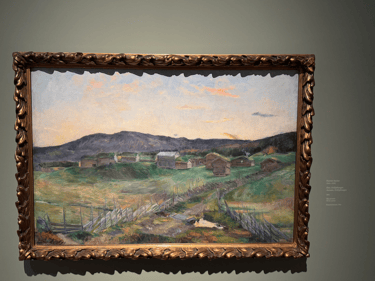
Among all these rooms and interiors, a single landscape stands apart — Heia, Drøbakveien, Bærum (1894, Nasjonalmuseet, Oslo). A Norwegian valley at what looks like early evening or late summer — the sky pink and pale above blue hills, the scattered farmhouses and fences of the valley floor below, the meadows still catching the last of the light.
Backer painted few landscapes, which makes this one feel like a held breath — a pause in her career-long preoccupation with enclosed space. And yet the sensibility is entirely consistent. She is interested in the same question she asks of every room: what is this particular light doing to this particular place, right now, and how do you render that honestly?
The Self-Portrait: Unfinished, Unguarded
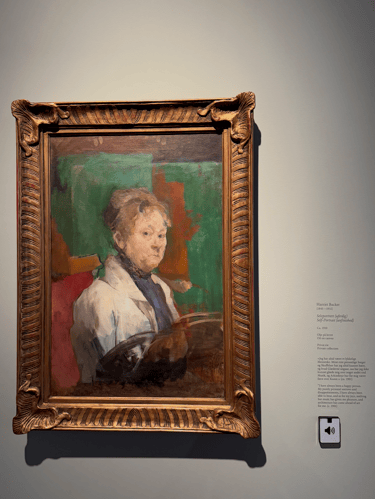
The last painting I want to name is the one I found hardest to leave: Self-Portrait (unfinished) (c. 1910, private collection).
Backer is in her mid-sixties. She holds a palette. The background is a wash of green, red, and orange — studio colours, in-progress colours — that look remarkably like an abstract painting half a century before abstraction became a movement. She is looking slightly away from the viewer, and her expression is not easy to read. It is not modest and it is not triumphant. It is simply alert.
Beside the painting, a quote from her journal, written around 1901: "I have always been a happy person. My purely personal sorrows and disappointments, I have always been able to bear, and as for my joys, nothing but music has given me pleasure, and architecture has come ahead of art for me."
Art in third place. After music and architecture. From a painter who produced work of this quality, that ranking is either a peculiar form of false modesty or the most honest thing she ever wrote. I suspect it is both.
Interiør fra Rochefort-en-Terre, Bretagne (1892) — Brittany farmhouse interior, National Museum Oslo
Fra Cluny-museet / From the Cluny Museum (1885) — Private collection
Blå Interiør / Blue Interior (c. 1881) — Rasmus Meyer Collection
Bondeinteriør, Skotta i Bærum / Farmhouse Interior, Skotta, Bærum (1887) — National Museum Oslo
Syende kvinne ved lampelys / Woman Sewing by Lamplight (1890) — National Museum Oslo
Heia, Drøbakveien, Bærum (1894) — National Museum Oslo
Lekseøvning / Homework (1888) — Lillehammer Art Museum
Hos bestemor / At Grandmother's House (1888) — Private collection
Blekedagen / The Bleaching Field (c. 1889) — Kode, Bergen
Afteninteriør / Evening Interior (1890) — Private collection
Ripaust (undated) — Stavanger Art Museum
Ved pianoet / At the Piano (1894) — National Museum Oslo
Ved oldemors klaver / At Great-Grandmother's Piano — Private collection
Chez moi (1887) — National Museum Oslo
Interiør fra Øidal Aurdals kirke — Aure
Inngangshuset, sakristiet i Tanum kirke / Churching, the Sacristy in Tanum Church (1892) — Kode, Bergen
Sjelesorg / Pastoral Care (1892) — Private collection
Interiør fra Mariakirken / Interior from St Mary's Church (1913) — Kode, Bergen
Åpnedøp i Tanum kirke / Christening in Tanum Church (1892) — National Museum Oslo
Selvportrett (uferdig) / Self-Portrait (unfinished) (c. 1910) — Private collection
